Cities Leading
Food Production
Programme tracks
Tech & Health | Governance | Ecosystem Restoration | Water
| Youth | Finance & Investment | Food Security & Resilience
Workshop
Event
Keynote
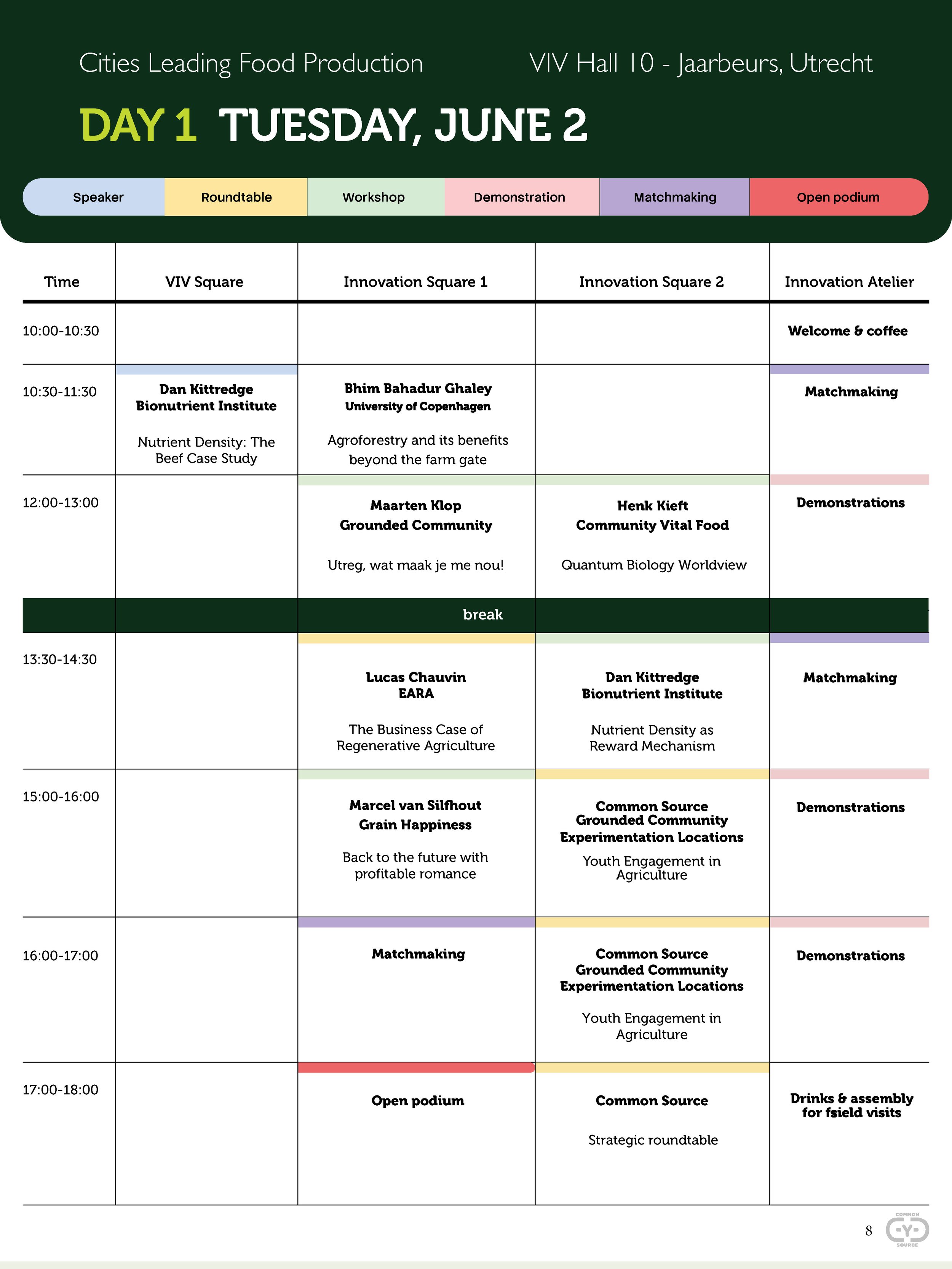
TUESDAY JUNE 2
Conference center
11:30 - 12:30
Dan Kittredge - Nutrient Density and agribusiness opportunities
12:30 - 13:30
Fabio Volkmann - Regenerative agriculture business cases
Square 1
10:30 - 11:30
14:00 - 15:00
Square 2
10:30 - 11:30
14:00 - 15:00
CLFP Square
10:30 - 12:30
Strategic partnerships & trusted space
12:15 - 14:00
Online dating
15:00 - 16:00
Common Source Living Lab workshop
15:15 - 17:00
Online dating
16:00 - 18:00
Drinks & Bites
Field visit 1
Grounded Community
Field visit 2
Dutch Waterline
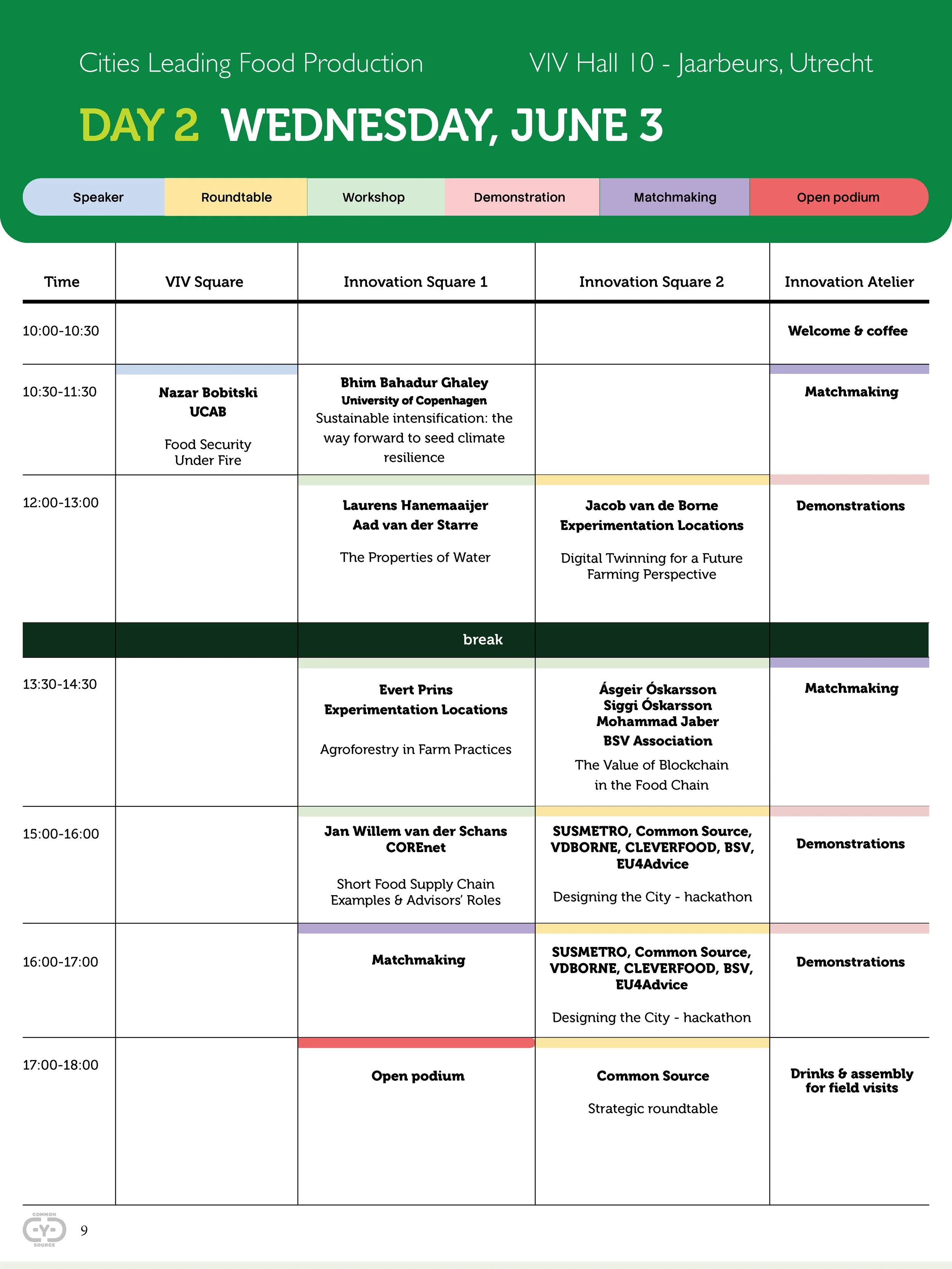
WEDNESDAY JUNE 3
11:30 - 12:30
Oleksandra Avramenko - Ukraine and food security & resilience
12:30 - 13:30
10:30 - 11:30
14:00 - 15:00
10:30 - 11:30
14:00 - 15:00
10:30 - 12:30
Strategic partnerships & trusted space
12:15 - 14:00
Online dating
15:00 - 16:00
Common Source Living Lab workshop
15:15 - 17:00
Online dating
16:00 - 18:00
Drinks & Bites
Field visit 1
RijnVliet
Field visit 2
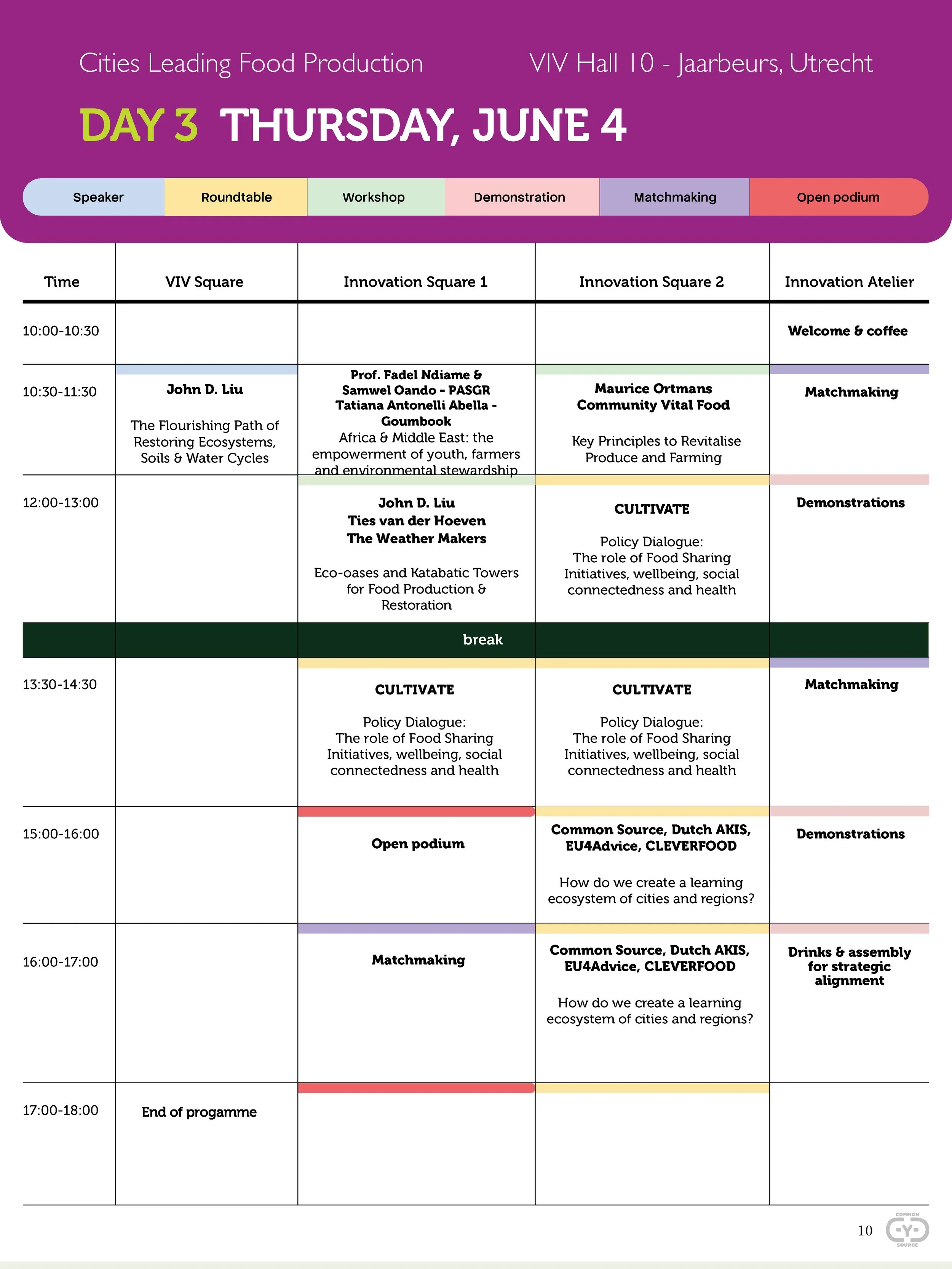
THURSDAY JUNE 4
11:30 - 12:30
12:30 - 13:30
10:30 - 11:30
14:00 - 15:00
10:30 - 11:30
14:00 - 15:00
‘Utrecht, what are you doing!’ network
10:30 - 12:30
Strategic partnerships & trusted space
12:15 - 14:00
Online dating
15:00 - 16:00
Common Source Living Lab workshop
15:15 - 17:00
Online dating
16:00 - 18:00
Drinks & Bites
Field visit 1
Policymaker
engagement
Roundtable
Utrecht bike ride, walk & bite
Steck
Programme partners
-
HubOrange! is an innovative platform and network connector in the agribusiness and food sector.
It gives stage to groundbreaking innovations and brings together farmers, producers, companies, and stakeholders to accelerate the regionalisation of food production.
HubOrange! promotes shorter, more sustainable, and circular supply chains — with the primary producer at the heart of innovation. Through its Inspiration Square, events, and collaborations (such as with Royal Jaarbeurs and VIV Worldwide), it showcases practical solutions like “The Round Egg” circular concept and supports glocal farming for transparent, future-proof food systems.
Focused on sustainability, regional resilience and real-world impact, HubOrange! inspires and connects the entire food ecosystem toward a more local and responsible way of feeding the world.
-
Common Source is an innovative Dutch initiative dedicated to building resilient and future-proof food systems through mass participation and collaboration.
Using nature-based principles for steering, it creates a dynamic learning ecosystem of networks that brings together cities, regions, farmers, innovators, and stakeholders. The focus is on shifting toward regional and urban food production to strengthen food security, resilience, and sustainability — especially in the face of global challenges.
Key efforts include ‘Cities Leading Food Production’, active involvement in major events such as VIV Europe and VIV MEA, and collaborations with partners like HubOrange!, Royal Jaarbeurs, and Compazz Foundation.
Common Source unlocks new market leadership by turning collective intelligence and regenerative approaches into practical action for a more secure and sustainable food future.
-
The European Alliance for Regenerative Agriculture (EARA) is an independent, farmer-led coordination and advocacy organisation for regenerative agriculture at European level.
Rooted in pioneering farmers from diverse European contexts, it works to transform agrifood systems through ecological, economic and social regeneration starting with living soils. EARA promotes a farmer-centric Common Agricultural Policy focused on agroecosystem health, fair structures, attractive farm labour conditions, and context-specific innovation.
It argues that current agrifood systems are a major driver of the earth’s degradation and health issues, and highlights regenerative farmers’ evidence on biodiversity, water, carbon, productivity, crop health, nutrition and farm economics.
EARA engages in EU policy debates through initiatives such as the EU Soil Health Law coalition and its own white papers, aiming to place farmers’ voices at the centre of decision-making.
-
The Bionutrient Food Association (BFA) is a membership organization dedicated to building a new food culture rooted in nutrient density, soil health, and transparency.
Founded in 2010, its mission is to increase the quality of the food supply by supporting growers, educating consumers, and developing practical tools to measure and improve nutritional value in food.
Key initiatives include the Bionutrient Institute for scientific research, the annual Soil & Nutrition Conference, grower education programs, on-farm consultations, and innovative tools like the Bionutrient Meter, Brix Kit, and Garden Kit to help assess and enhance nutrient levels.
BFA empowers farmers, scientists, and eaters to reconnect with truly nourishing food — grown in vital, living soil.
-
The Bionutrient Institute is the scientific research arm of the Bionutrient Food Association (BFA).
Its mission is to increase quality in the food supply by defining and measuring nutrient density — the real nutritional value of food — through rigorous scientific inquiry.
The Institute investigatees the links between agricultural management practices, soil health, seed genetics, cultivars, and the nutrient content of crops. It develops practical tools and methods to make nutrient levels detectable and transparent, empowering consumers to choose higher-quality food and incentivizing growers to build biologically vital, carbon-rich soils.By studying interconnections between soil, plants, ecosystems, and human health, the Institute supports regenerative practices that enhance nutrition, improve human and planetary health, and contribute to climate stability.
Through open-source data, lab research, and collaboration, it drives a paradigm shift toward truly nourishing food grown in living soils.
-
Friends of the Ecosystem Restoration Movement is a 501(c)(3) nonprofit organization dedicated to global ecological restoration.
Its mission is to enhance mass collaboration and participation by empowering communities through shared knowledge, regenerative practices, and collective intelligence. The organization supports the development of living laboratories across continents, spreading proven methodologies for ecosystem stewardship that prioritize the well-being of all life forms, the commons, and territories.
Key initiatives include Botanical Sanctuaries, plant-based Water Remediation systems, and sustainable Tree Nurseries. Through education, mentorship, media, events, and festivals, it fosters multi-generational and multicultural efforts to heal degraded lands and restore peaceful human-Earth relationships.
Healing the Earth and the human spirit — join the movement by becoming a Friend.
-
The Weather Makers is a pioneering Dutch company specializing in nature-based design, engineering, and project management. With the tagline “Engineering Earth’s Comeback,” they develop systemic solutions for a resilient future by intelligently integrating ecosystems, people, data, and technology.
Their innovative approach restores water cycles, enhances climate adaptation, and creates sustainable infrastructure — from mangrove restoration and wave energy projects to building water security in drought-affected regions.
By combining nature’s wisdom with multidisciplinary expertise, The Weather Makers turn visionary ideas into scalable impact, helping shape a thriving world together.
-
The BSV Association is a Switzerland-based non-profit organisation and global advocate for the BSV blockchain.
Its mission is to advance adoption by advocating for, educating about, and driving innovation on BSV — the scalable blockchain that follows the original Bitcoin whitepaper for secure, instant, and low-cost transactions at massive scale.
The Association empowers developers, businesses, governments, and individuals through practical education (Blockchain 101, webinars, glossary), comprehensive developer tools and documentation, publications, and community programmes including the Developer Relationship Programme and a global Ambassadors network.
Focused on real-world utility, it helps unlock blockchain’s potential for transparency, efficiency, and trustworthy systems.
-
UNISOT is a leading Asset Traceability Platform powered by enterprise blockchain and AI, designed for all industries.
It enables companies to prove product provenance — including origin, sustainability, quality, safety, ingredients, and ethical sourcing — from raw materials to the end consumer.
With a ‘Zero-Barrier-of-Entry’ vision and no upfront capital costs, UNISOT offers a scalable SaaS solution that incentivizes every supply chain actor — from individual farmers to global multinationals — to join an open global data layer.
Key features include Digital Product Passport (DPP), Global Inventory Management, Blockchain Data Interchange, IoT integration, Life Cycle Assessment, and secure document collaboration.
UNISOT helps businesses enhance transparency, ensure regulatory compliance (such as EU DPP requirements), reduce waste, and build consumer trust.
-
Vitaal Voedsel (Vital Food) is a network of passionate people working to promote healthy soil, healthy plants and animals, healthy food and healthy people.
The organisation takes a holistic and integrated approach to agriculture, nutrition and human health, viewing the landscape as a ‘pharmacy’ and the farmer as a potential doctor of the future.
From this perspective, Vitaal Voedsel aims to promote the importance of vital, life-giving food to producers and consumers. They organise regular meetings and join in with activities organised by partner organisations to raise awareness of vital agriculture, healthy food and a resilient agro-ecosystem.
Theoretically, the movement aligns with ideas surrounding quantum agriculture, as outlined in the online book “Nature & Agriculture: There’s Music in It” by Henk Kieft, which links scientific insights with practical experience.
-
Copa-Cogeca is the main EU-level agribusiness lobby representing European farmers and agricultural cooperatives. It unites Copa (professional farmers’ organisations) and Cogeca (agricultural cooperatives), claiming to speak for over 20 million farmers and thousands of co-ops across the EU.
Based in Brussels, it is a key interlocutor for EU institutions on the Common Agricultural Policy, trade, and internal market regulation. Copa-Cogeca advocates a competitive, sustainable and innovative farming model, prioritising farm incomes, export opportunities, and food security for EU citizens. -
The Ukrainian Agribusiness Club (UCAB) is a business association representing leading companies across Ukraine’s agro-food sector.
It aims to shape the country’s agricultural future by improving the business environment, supporting market development, and strengthening the global competitiveness of Ukrainian agribusiness.
UCAB provides its members with policy advocacy, market analytics, and platforms for dialogue with government, international partners, and other stakeholders. Through expert commentary, analytical reports, and events, it addresses issues such as exports, taxation, land market reform, machinery, climate challenges, and alignment with EU regulations.
More than 200 companies have joined UCAB, making it a key voice for Ukraine’s agricultural producers, processors, and service providers, especially under wartime and post-war recovery conditions.
-
The National Platform for Agricultural Experimental Sites is a nationwide initiative of the Ministry of Agriculture, Fisheries, Food Security and Nature (LVVN).
Since February 2026, twelve local experimental sites have been joining forces to accelerate innovation in agriculture and horticulture. Farmers, horticulturalists, researchers and supply chain partners test practical solutions here directly on the farm, in greenhouses and in the fields.
Think of biological pest control, robotisation, precision farming with drones, alternative soil cultivation and the planting of farm forests. The platform ensures that local knowledge and experiences are shared, scaled up and translated into national policy.
Goal: future-proof, sustainable agriculture that is vital for both farmers and society. The platform is ‘by, for and through the experimental sites’.
-
The Partnership for African Social and Governance Research (PASGR) is an independent, non-partisan, pan-African, not-for-profit organisation established in 2011 and based in Nairobi, Kenya.
Active in more than 26 African countries, PASGR advances research excellence and capacity strengthening for evidence-informed governance and social policy. PASGR’s vision is a vibrant African social science community addressing the continent’s public policy issues and improving the wellbeing of women and men.
Guided by values such as integrity, excellence, responsiveness, collaboration, collegiality and diversity, PASGR works with universities, research institutes, think tanks, civil society, business and policy actors across Africa and internationally.
It supports the production and dissemination of policy-relevant research, delivers professional development courses for researchers and policy practitioners, and facilitates collaborative higher education programmes. -
Goumbook is a leading social enterprise founded in 2009, accelerating sustainability and climate action across the MENA region (Middle East and North Africa).
Its mission is to change mindsets and shape a more sustainable future by delivering local solutions for corporates, youth, civil society, and the public sector. Goumbook mobilises cross-sector collaboration to tackle the region’s unique challenges in climate action, biodiversity, water, circularity, food systems, and human wellbeing.
Key initiatives include awareness campaigns, tailored programmes, advisory services, and the impactful MENA Regenerative Agriculture Venture Programme, which supports scientists and students in turning research into scalable, nature-based solutions for soil health, food security, and climate resilience.
Goumbook drives tangible impact by connecting stakeholders and fostering innovative, regionally relevant sustainability practices.
-
MENA Regenerative Agriculture Venture Programme is an accelerator initiative by Goumbook, designed to empower scientists, researchers, and students across the MENAT region (Middle East, North Africa, and Türkiye).
Launched as part of Goumbook’s broader Regenerative Agriculture Initiative, the programme helps participants develop regenerative and entrepreneurial skills to turn research-based and nature-based solutions into scalable proof-of-concepts.
It addresses critical regional challenges such as food security, soil health, water scarcity, desertification, salinity, biodiversity loss, and climate resilience through innovations in regenerative agriculture.
Participants benefit from free self-paced courses, specialist mentorship, expert talks, networking, regional exposure, and access to a digital community platform. Top finalists receive grants (up to $20,000), incubation support, and further acceleration opportunities.
-
EU4Advice is a five-year, multi-actor Horizon Europe project that strengthens advisory support for Short Food Supply Chains (SFSCs) across Europe.
It focuses on improving the economic, social and environmental sustainability of SFSC actors by boosting the role of advisors as catalysts of knowledge transfer from research to practice.
The project builds an EU-wide network of SFSC advisors, integrates them into national Agricultural Knowledge and Innovation Systems (AKIS), and develops educational tools and policy recommendations for advisors and policymakers.
Through four Living Labs in Spain, the Netherlands, Ireland and Hungary, EU4Advice tests innovative governance models and advisory methods in real-world food system contexts.
-
COREnet is a Horizon Europe-funded project coordinated by the University of Foggia, focusing on Short Food Supply Chains (SFSCs) to foster inclusive, resilient, and sustainable food systems across Europe.
Launched in September 2022, it builds on the H2020 SKIN project by creating a pan-European peer-to-peer learning network for SFSC advisors, practitioners, farmers, and stakeholders.
-
The Athena Institute at Vrije Universiteit Amsterdam is a leading transdisciplinary research and education institute dedicated to connecting science and society for societal transformations.
Its mission is to make research, innovation, and policy more responsive to societal needs by bridging the gap between science, policy, practice, and diverse societal actors. Through inclusive and reflexive methodologies, the institute fosters multi-actor collaboration to tackle complex challenges such as health inequalities, climate change, digitalisation, social justice, and systemic transformations.
Athena operates at the interface of science, technology, and society, with research organised around four key domains: Emerging Science & Technology, Global Health & Well-being, Food, Environment & Sustainability, and Competencies for Transformation.
By promoting mutual learning and transdisciplinary approaches, the institute drives fair, inclusive, and impactful solutions for a better tomorrow.
-
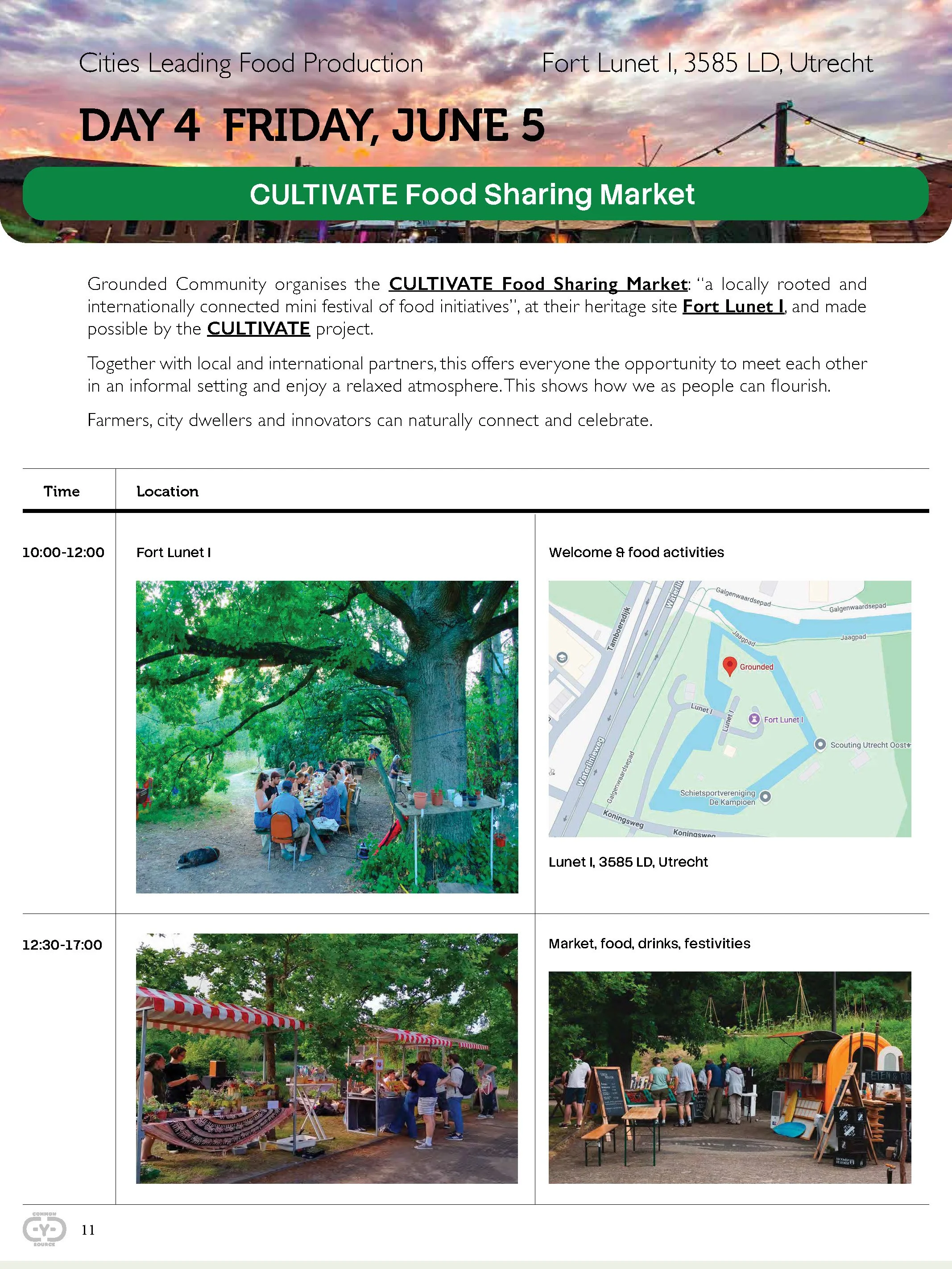
Grounded is a 100% community-powered collective in Utrecht, dedicated to sustainability, social awareness, and the alternative non-commercial scene. We empower the regenerative generation by transforming historic forts of the Nieuwe Hollandse Waterlinie into vibrant ecological and cultural hubs for climate action, education, and connection.
Through hands-on community gardening, sustainable Grounded Kitchen catering, workshops, festivals, and self-managed circles using Holacracy, we foster regenerative practices, shared food culture, and inclusive community building—from seed to soil and defense to resilience.
-
‘Utreg, wat maak je me nou!’ (Utrecht, what are you doing!) is a dynamic area-based collaboration initiative in Utrecht aimed at building a connected and impactful local food system.
Initiated by Common Source and HU University of Applied Sciences Utrecht (with support from the EU4Advice Living Lab), it brings together the vibrant Utrecht food movement — including food forests, Community Supported Agriculture (CSA), community kitchens, short food chains, nature restoration, and education projects.
Through inspirational meetings, co-creation sessions, and working groups, participants map needs and opportunities, form project clusters, and develop concrete action and financing plans. The goal: to turn diverse ambitions into effective, collective projects for a greener, healthier, and happier Utrecht.
By fostering area-specific collaboration and shared knowledge, the initiative strengthens regional resilience and regenerative food practices.
-
Utrecht is a vibrant hub in the EU-funded CULTIVATE project, dedicated to co-designing innovative food sharing for resilient and sustainable urban food systems.
In collaboration with the municipality, Wageningen University, and Cascoland, Utrecht transforms neighborhoods into edible landscapes. The highlight is Rijnvliet, the Edible Neighborhood—a co-created food forest with public edible green spaces that boosts community cohesion, health, and sustainability.
Key activities include Lab & Kitchen pop-ups for deliberative encounters, serious games to raise awareness on food waste, and citizen engagement tools that make sharing fun and impactful. Aligned with the city’s ‘Healthy Urban Living’ strategy, these initiatives reduce waste, foster social connections, and promote environmental education.
-
Copa-Cogeca is the main EU-level agribusiness lobby representing European farmers and agricultural cooperatives.
It unites Copa (professional farmers’ organisations) and Cogeca (agricultural cooperatives), claiming to speak for over 20 million farmers and thousands of co-ops across the EU.
Based in Brussels, it is a key interlocutor for EU institutions on the Common Agricultural Policy, trade, and internal market regulation. Copa-Cogeca advocates a competitive, sustainable and innovative farming model, prioritising farm incomes, export opportunities, and food security for EU citizens. It coordinates positions through numerous internal committees and working parties, then pushes these line-by-line in EU legislative processes.
Researchers and NGOs often describe it as the most influential farm lobby in Brussels, with strong access to national ministries and EU decision-makers.
-
Compazz is an independent Dutch foundation dedicated to accelerating the circular economy and driving sustainable innovation and transition.
Its mission is to initiate, advise, guide, and inspire projects, organizations, and individuals with ambitious circular and sustainability goals. Through a strong international network, Compazz helps overcome obstacles that slow down circular initiatives, turning challenges into actionable solutions.
Key activities include sustainability policy analysis, strategy development, multi-stakeholder collaboration, communication strategies, and public engagement events to raise awareness and support for the circular economy.
Compazz connects motivated people and organizations, facilitating the systemic change needed for a truly sustainable future.
-
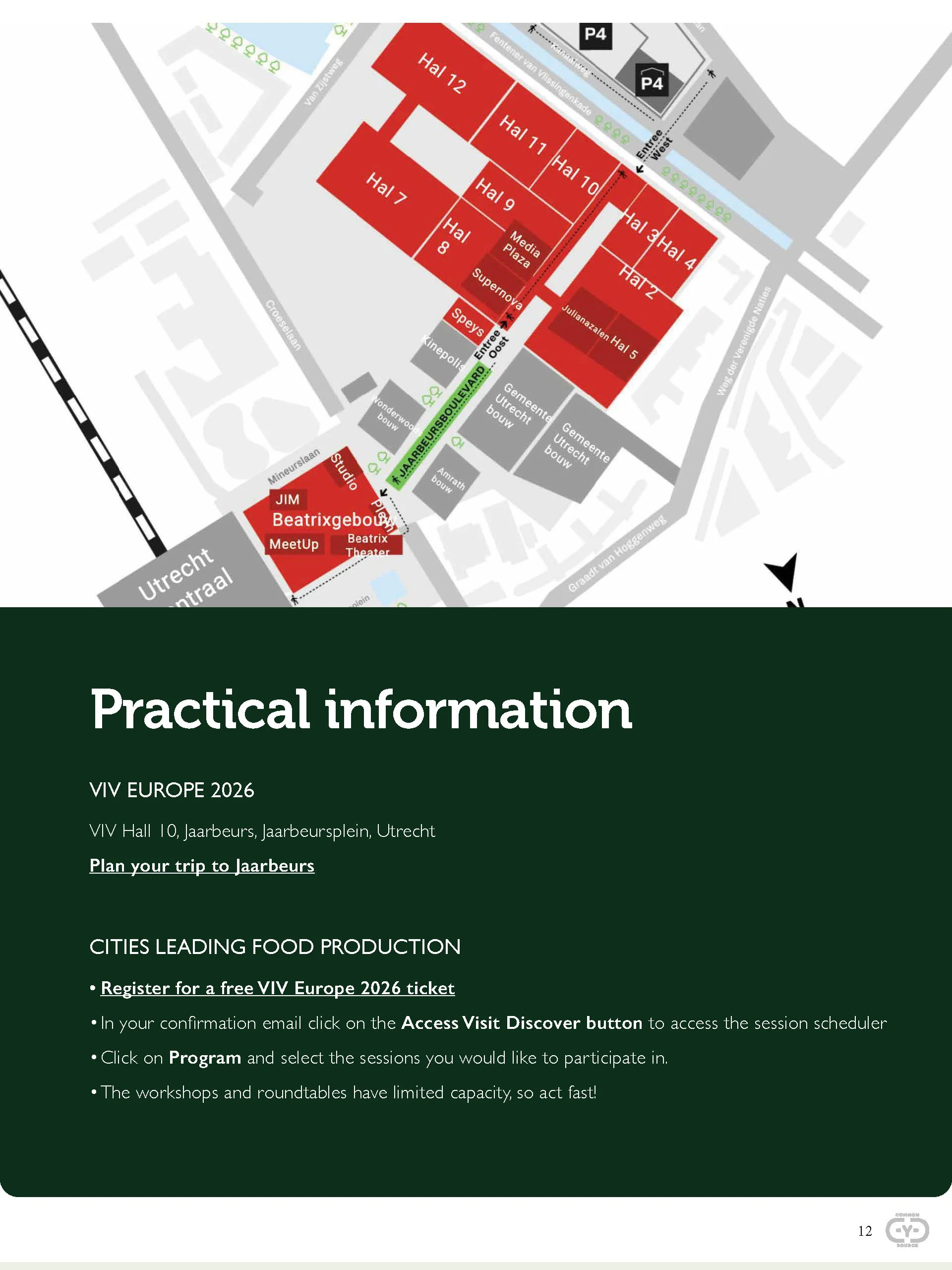
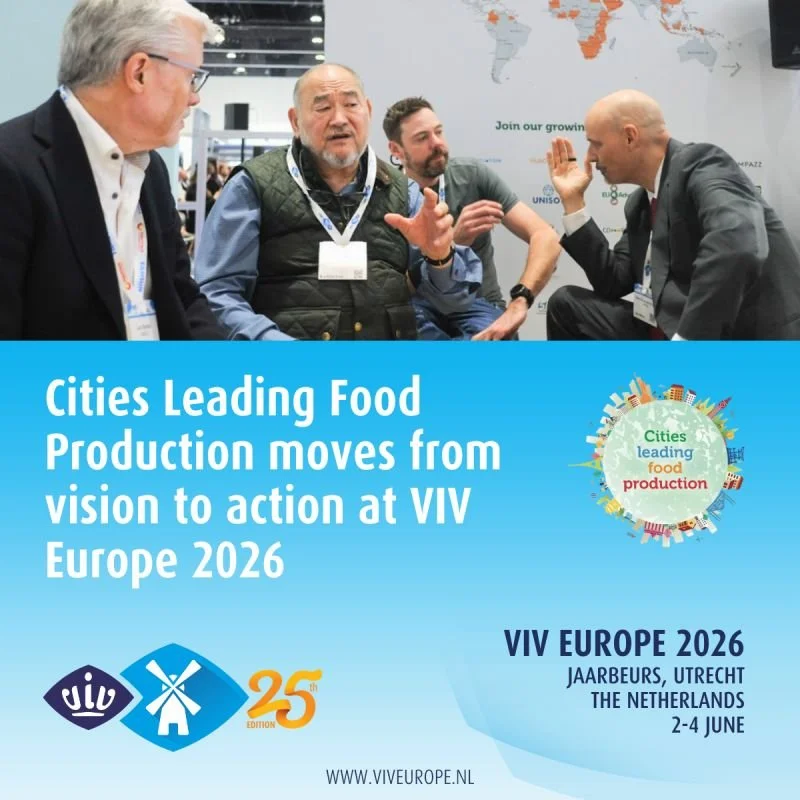
VIV Europe is the leading international World Expo from Feed to Food for animal and poultry husbandry.
Held every two years in Utrecht, the Netherlands (next edition: 2-4 June 2026), it serves as the premier global B2B platform for the entire animal protein production chain — from feed and grain technology to breeding, farm production, animal health, processing, and logistics.
The event brings together over 600 exhibitors and around 20,000 professionals from more than 140 countries. It showcases the latest innovations in sustainable farming practices, digital solutions, automation, and technologies for poultry, pigs, dairy, aquaculture, and eggs.
VIV Europe connects suppliers, integrators, and decision-makers to drive knowledge exchange, business opportunities, and better farming practices for a more sustainable and efficient livestock sector.